
Why Trust Layer Correlation Analysis Must Precede Every Post-Quantum Cryptography Migration
Why Trust Layer Correlation Analysis should be the first step of every PQC migration program, how trust dependencies impact critical business transactions, and why successful quantum-safe transformation is ultimately about preserving business trust—not just upgrading cryptography.
6/5/20266 min read
My post content
The Great Misconception About PQC Migration
The global conversation around Post-Quantum Cryptography (PQC) has accelerated significantly over the last few years. Governments, regulators, standards bodies, and technology vendors are all preparing for a future where quantum computers possess the capability to break many of the public-key cryptographic algorithms that secure today's digital world.
As organizations begin planning their quantum-safe journey, many executives view PQC migration as a technology refresh initiative. The assumption is straightforward: identify vulnerable cryptographic algorithms, replace them with NIST-approved quantum-resistant algorithms, and continue business as usual.
Unfortunately, reality is far more complex.
Cryptography does not exist in isolation. It exists within a web of trust relationships that have evolved over decades. Every login, every digital certificate, every application connection, every API call, every software update, every VPN tunnel, and every cloud workload operates because one system trusts another.
The challenge is not replacing cryptographic algorithms.
The challenge is preserving trust while replacing the cryptographic foundations upon which that trust is built.
This is why the most successful organizations are beginning their quantum-safe journey with Trust Layer Correlation Analysis rather than algorithm migration.
Trust Layer Correlation Analysis seeks to answer a fundamental question:
"What business, operational, and security relationships depend on each cryptographic asset across the enterprise?"
Without understanding these dependencies, organizations risk introducing outages, breaking critical applications, disrupting customer services, and creating compliance failures while attempting to improve security.
The future of PQC migration is not cryptography-first. It is trust-first.
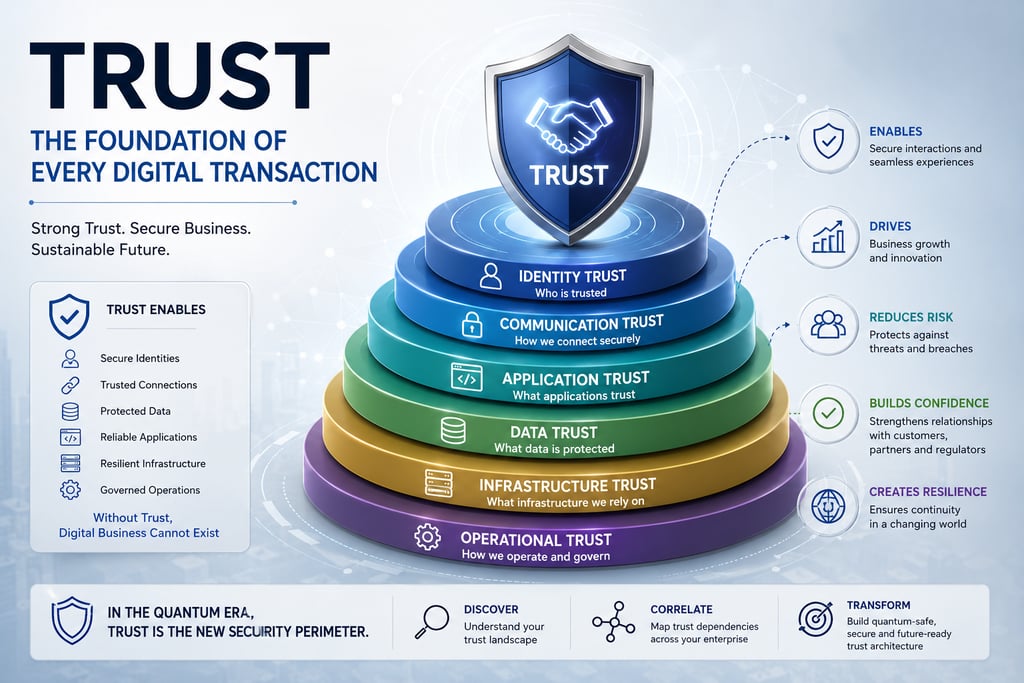
Understanding Enterprise Trust Layers
Every enterprise operates through multiple interconnected trust layers.
These layers are often invisible because they function silently in the background. Yet they form the foundation upon which digital business operates.
The Identity Trust Layer establishes who is trusted. Employees authenticate into enterprise systems. Applications authenticate to other applications. Devices authenticate to networks. Digital certificates, identity providers, privileged access systems, and machine identities all contribute to this layer.
The Communication Trust Layer establishes how trusted entities communicate. Virtual private networks, SD-WAN architectures, TLS sessions, cloud connectivity, partner integrations, and API gateways all depend on cryptographic trust.
The Data Trust Layer protects information throughout its lifecycle. Customer records, financial transactions, healthcare information, intellectual property, and operational technology data rely on encryption and key management systems to maintain confidentiality and integrity.
The Application Trust Layer determines which software components trust one another. Modern enterprises may operate hundreds or thousands of applications connected through APIs, microservices, software supply chains, and digital signing mechanisms.
The Infrastructure Trust Layer governs trust within servers, storage systems, cloud platforms, network devices, and security appliances. Secure boot mechanisms, firmware signatures, hardware security modules, and platform certificates all contribute to this layer.
Finally, the Operational Trust Layer enables governance, monitoring, compliance reporting, risk management, and cybersecurity operations.
Although these layers appear separate, they are deeply interconnected.
A single cryptographic certificate may influence multiple trust layers simultaneously.
A root certificate authority may underpin employee authentication, application communication, VPN connectivity, cloud workloads, and regulatory compliance processes.
Changing one cryptographic component can therefore impact dozens or even hundreds of business services.
This interconnected reality is precisely why trust-layer correlation analysis is becoming a prerequisite for quantum-safe transformation.
Example - Following a Single Financial Transaction Through Enterprise Trust Layers
Consider a simple business transaction.
A corporate customer initiates a ₹50,00,000 supplier payment through the bank's digital banking platform.
To the customer, this appears to be a single action. However, behind the scenes, the transaction passes through multiple trust layers and cryptographic controls.
Step 1: Identity Trust Layer
The customer logs into the banking application.
Trust is established through:
User credentials
Multi-factor authentication (MFA)
Identity provider validation
Device authentication
Session management certificates
The bank must trust that the person initiating the transaction is genuinely authorized to do so.
Step 2: Communication Trust Layer
The payment request is transmitted securely.
Trust is established through:
TLS certificates
VPN or secure network channels
API gateway authentication
Mutual TLS between systems
Secure SD-WAN connectivity
The bank must trust that the transaction has not been intercepted or altered during transmission.
Step 3: Application Trust Layer
The request enters the bank's application ecosystem.
Trust is established between:
Mobile banking application
API gateway
Fraud management platform
Payment processing engine
Core banking application
Each application verifies the identity and authenticity of the other applications before processing the transaction.
Step 4: Data Trust Layer
The transaction data must remain protected.
Trust is established through:
Database encryption
Encryption key management
Digital signatures
Data integrity controls
Secure backup systems
The bank must trust that the payment amount, beneficiary details, and transaction records remain accurate and unaltered.
Step 5: Infrastructure Trust Layer
The underlying infrastructure validates and executes the transaction.
Trust is established through:
Server certificates
Hardware Security Modules (HSMs)
Secure boot mechanisms
Firmware signing
Cloud platform trust anchors
The applications must trust the infrastructure upon which they are running.
Step 6: Operational Trust Layer
The transaction is monitored, logged, and governed.
Trust is established through:
SIEM monitoring
Audit logging
Regulatory reporting
Risk management controls
Compliance systems
The bank must be able to prove that the transaction was executed securely and in accordance with regulatory requirements.
What Happens During PQC Migration?
Suppose the bank replaces a cryptographic certificate within its API infrastructure as part of a PQC migration initiative.
Without Trust Layer Correlation Analysis:
The customer may still successfully log in.
The mobile application may appear to function normally.
The payment engine may fail certificate validation.
Fraud monitoring systems may lose transaction visibility.
Internal APIs may reject trusted connections.
Settlement systems may refuse digitally signed messages.
Regulatory logging may become incomplete.
The result is simple:
"Transaction Failed"
The cryptographic migration succeeded.
The business transaction failed.
The Key Lesson
A ₹50,00,000 payment transaction depends on dozens of interconnected trust relationships across the enterprise.
Before replacing any cryptographic algorithm, certificate, key, or trust anchor, organizations must understand:
Which systems rely on it.
Which applications consume it.
Which business services depend on it.
Which transactions will be affected if it changes.
This is why Trust Layer Correlation Analysis should be the first phase of every Post-Quantum Cryptography migration program.
The objective of PQC migration is not to protect cryptographic assets. The objective is to protect the business transactions that depend upon them.
Why Trust Correlation Analysis Becomes Mission Critical
The majority of enterprises do not possess a complete inventory of their cryptographic assets.
Certificates are often distributed across data centers, cloud environments, SaaS applications, network infrastructure, operational technology systems, and third-party platforms.
Many organizations also suffer from what security teams refer to as "cryptographic sprawl."
Over time, certificates become duplicated, undocumented, forgotten, or embedded within legacy systems. Hardcoded keys remain hidden inside applications. Third-party integrations rely on outdated trust mechanisms. Critical dependencies exist that nobody fully understands.
This creates a dangerous situation for PQC migration.
An organization cannot effectively modernize cryptography if it lacks visibility into where cryptography exists and how trust relationships are established.
Trust Layer Correlation Analysis addresses this challenge by creating a comprehensive map of cryptographic dependencies across the enterprise.
The process identifies cryptographic assets, maps their relationships to business services, determines operational impact, classifies migration risks, and prioritizes transformation activities.
Most importantly, it enables leaders to answer critical business questions.
Which services are most vulnerable?
Which systems are dependent upon legacy cryptography?
Which trust relationships represent the highest business risk?
What sequence of migration activities minimizes disruption?
How should investments be prioritized?
By providing these answers, trust correlation analysis transforms PQC migration from a technical exercise into a business-driven transformation program.
The result is greater confidence, lower risk, and significantly improved migration outcomes.
The Future of Quantum-Safe Transformation
The transition to quantum-safe security will likely become one of the largest infrastructure modernization efforts undertaken by enterprises over the next decade.
Unlike previous technology refresh cycles, PQC migration affects the very foundations of digital trust.
Organizations that focus solely on algorithm replacement may discover that they are solving the wrong problem.
The true challenge is understanding how trust flows through the enterprise.
Before migrating certificates, organizations must understand who depends on those certificates.
Before upgrading encryption, organizations must understand what business processes rely upon that encryption.
Before modernizing PKI, organizations must understand how trust relationships span applications, networks, cloud platforms, identities, and operational processes.
This is why Trust Layer Correlation Analysis should become the first phase of every PQC migration program.
At Uroniyx, we believe the future belongs to organizations that treat quantum-safe transformation as a Trust Architecture Modernization initiative rather than a cryptographic replacement project.
Through capabilities such as cryptographic discovery, trust mapping, dependency analysis, crypto-agility governance, migration orchestration, and continuous visibility, organizations can establish a controlled and measurable path toward quantum resilience.
The journey to quantum safety does not begin with a new algorithm.
It begins with understanding trust.
Because in the quantum era, the organizations that survive will not simply be those that deploy stronger cryptography.
They will be the organizations that understand, govern, and modernize trust itself.
Uroniyx Technologies helps enterprises assess cryptographic risks, map trust dependencies, establish crypto-agility, and execute end-to-end quantum-safe transformation programs through its Quantum-Safe Infrastructure (QSI) platform and advisory services.
Connect with Us
Uroniyx Technologies provides a quantum-safe digital infrastructure platform enabling critical infrastructure and regulated mid-market enterprises to assess quantum risk and transition securely to post-quantum-ready environments
Contact
Email US
info@uroniyx.com
+91 9930683742
© 2025. Uroniyx Technologies Pvt Ltd, All rights reserved.